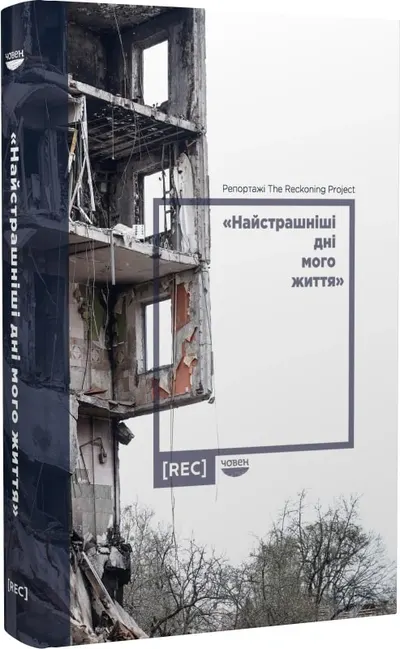
Of all the books that claim to be “reportages” about the current Russian-Ukrainian war, this one looks the closest to true reporting, but I still had problems trying to understand its structure and message. This is a collection of several reports about some of the tragedies of the full-scale invasion: bombardment of one civilian building in Chernihiv, the villagers of Yahidne captured as hostages and a human shield in a school basement for several weeks, bombardment of a maternity hospital in Mariupol, occupation of the Chornobyl disaster area by the Russians, shelling of the railway station in Kramatorsk, etc. All these stories are incredibly important, of course, and it is necessary to investigate them and provide more information about them. However, given the whole scale of various tragedies (these ones and many, many others, no less important and impressive), I did not understand why these particular stories were chosen for this (pretty thin) book, and not other ones, and why they are discussed here in such a superficial manner. Why the tragedy of Mariupol takes just about 10 pages here, and you basically would not learn much about it from this book if, let’s imagine, you did not follow the news and have not seen dozens of MUCH MORE IMPRESSIVE AND INFORMATIVE reports from it before. Besides, I have already read some of these materials in form of normal reportage/interview articles in various media, and I would say that it was a decent content for a quick war-time article but definitely not a good quality material for a book. Several of the materials included in this (again, ALREADY RATHER THIN) book are not reportages at all: they are reflective articles of the “coordinators” of the journalistic initiative, “The Reckoning Project” (Наталя Гуменюк, Пітер Померанцев, Джанін ді Джованні — and the latter one wrote TWO different articles for this book that basically talks about the same things over and over again, and I did not understand why she did not do it in just one material). From the very first pages, they underline that their reportages are special ones, as they pursue a very specific mission, namely: to gather evidence about war crimes and crimes against humanity in such a way that would be appropriate for their use as testimony in international courts as objective information, incontrovertible proof of those crimes. Great, thought I, let’s talk about this! I expected that they would explain this method and demonstrate on particular examples what exactly they do differently in order to make the evidence they collect suitable for such a purpose. I never learned about it from this book, and all the reports presented here looked to me very similar to all the other, pretty subjective, personal, and emotional evidence about the war we can find in any haphazard news material and overall were perceived as rather “weak” in terms of comprehensiveness, in-depth investigation of a particular subject, or incontrovertible impartiality, for example. Moreover, after every new story, you have a growing urge of asking “is it ALL YOU HAVE about this? seriously?!”. I do not want to say that those are bad stories or that I do not believe these people and do not respect their pain and losses; I just could not understand how exactly this project is different from a very trivial everyday journalistic coverage work and why exactly they decided to publish these particular stories in such a small and unimpressive book. Reading this book, one might have a feeling that crimes of the Russians are pretty limited in scale and strength, as such an ambitious journalistic/investigative project managed to collect only just a handful of stories and represent them in such a lame way. During these two years, I have read many reportages about various events in regular media, and many, TOO MANY of them impressed me much more than this book, and those were just regular and maybe not perfect journalistic works but they were still more informative, and interesting, and humane, and intelligent, and carefully prepared. I wanted to share them, to quote from them, to remember them. I do not have a single quote saved after reading this book. I also did not like here the comparisons of our war with situations in Chechnia and Syria. I mean: such comparisons are very legit and already obvious for people who have been actively investigating the subject but would not give much useful information in such a short form for the others; and anyway, all the wars are different, they all have their specifics, and our war is also VERY SPECIFIC, despite being just one of many other unforgivable transgressions of Russia. If we want to talk about all such transgressions and the general historical and military pattern overall, let’s start with the conquest of Siberia, and genocide of Tatars by Russia, and several centuries of its Caucasian wars, etc., etc., etc., but if you want to focus on only recent times, let’s not forget Georgia, and Moldova, and Russian mercenaries in Africa and ISIS, and the merciless explosions in Russia’s own buildings organized by the FSB — all this is part of the same pattern, and all this should be discussed in detail, yes, but this little book definitely wanted to talk about some narrower problems, didn’t it? Why not focus on something and discuss it properly? I already know some things about Chechnia, and I would not mention it fleetingly like this. It’s a very serious and complex problem, and the history of those wars definitely deserve a new investigation and reinterpretation today. I would love to read something intelligent and detailed about Syria, for example, and how it was similar or different there comparing to Ukraine, but I already imagine what a large and resource-consuming project it might be. And so on. Of course, read it if you want, I cannot say that it is a bad book or dissuade anyone from reading it. It was OK. (But isn’t it a bad sign when a journalistic approach to some of the biggest tragedies of people’s lives feels just like “OK”?)